Pediatric eye care in Robertsdale, AL helps parents understand how clearly their children see, how effectively their eyes work together, and whether their vision is developing as expected. These evaluations matter because children do not always recognize blurry vision or know how to explain visual discomfort.
A child may assume that everyone sees the same way they do. Some vision conditions also affect only one eye, allowing the stronger eye to compensate during ordinary activities. Regular screening and appropriate comprehensive examinations create opportunities to identify problems before they begin interfering with learning, sports, or daily confidence.
Vision Is Part of Childhood Development
Children rely on vision to identify faces, coordinate movement, judge distances, read, write, use classroom technology, and participate in sports. Clear eyesight is only one part of this system. The eyes must also align, focus accurately, track moving objects, and work together.
The Centers for Disease Control and Prevention explains that uncorrected vision problems may affect a child’s learning and ability to reach their potential. Appropriate eye care can support classroom participation, testing, behavior, and self-confidence when a vision condition is contributing to difficulty.
Vision is not the cause of every reading, attention, or academic concern. However, an eye examination can determine whether an identifiable visual problem is present and needs to be addressed alongside educational or medical support.
Screening and a Comprehensive Eye Exam Are Different
A vision screening is a brief check intended to identify children who may need additional evaluation. It may test distance vision or use an automated instrument to estimate refractive risk factors.
Screenings are valuable, but they have a narrower purpose than a comprehensive examination. A child can pass a basic screening while still experiencing difficulty with eye coordination, focusing, near vision, or another condition not included in that particular screening method.
The American Academy of Pediatrics describes vision screening for babies and children as an important part of preventive care. When a child does not pass, follow-up with an optometrist or ophthalmologist is important even if the parent has not noticed obvious symptoms.
A comprehensive pediatric eye exam may assess:
- Visual acuity at age-appropriate distances
- Nearsightedness, farsightedness, and astigmatism
- Eye alignment and movement
- How effectively the eyes work as a team
- Depth perception
- Focusing ability
- Pupil responses
- The health of the internal and external eye structures
When Should Children Have Their Vision Checked?
Children’s eyes should be observed and screened throughout development. The specific method changes with age because an infant cannot respond to the same test used for a school-aged child.
The American Association for Pediatric Ophthalmology and Strabismus publishes detailed vision-screening recommendations covering infancy through school age. Early checks may evaluate the red reflex, pupil response, eye movement, external structures, and the ability to follow an object. Later screenings can include symbol or letter-based visual acuity testing.
Robertsdale Eye Care recommends a first comprehensive examination around age one, another around age three, an exam before school, and yearly evaluations afterward. An individual child may need a different schedule based on symptoms, family history, premature birth, developmental concerns, an existing prescription, or a recommendation from another healthcare professional.
Parents should not wait for a routine schedule when they notice an unusual eye appearance, sudden visual change, injury, or persistent symptom.
Refractive Errors Can Be Difficult for Children to Recognize
Refractive errors occur when the shape of the eye prevents light from focusing properly on the retina. Common types include:
- Myopia: Distant objects appear blurry.
- Hyperopia: Near vision may be difficult, although children can sometimes compensate by focusing harder.
- Astigmatism: Vision may appear blurred or distorted at multiple distances.
The National Eye Institute’s overview of refractive errors notes that symptoms may include blurry vision, squinting, headaches, eye strain, or difficulty focusing while reading or using a computer.
Some children remain unaware of the blur because it developed gradually or has always been present. An examination can compare the two eyes independently and determine whether corrective lenses would improve functional vision.
Amblyopia Requires Early Attention
Amblyopia, often called lazy eye, develops when the brain begins relying more heavily on one eye because the other provides a weaker or less reliable image. It may result from a significant prescription difference between the eyes, eye misalignment, or an obstruction such as a childhood cataract.
Amblyopia does not always make an eye look different. A child may appear to function normally because the stronger eye takes over.
The National Eye Institute identifies amblyopia as a common cause of childhood vision loss and emphasizes that early treatment generally works well. Depending on the cause, treatment may involve glasses, patching, prescribed eye drops, or management of another underlying condition.
Parents should follow the exact treatment plan provided by their child’s eye-care professional. The amount of patching or medication required varies, and excessive unsupervised treatment can create additional problems.
Eye Alignment and Binocular Vision
For comfortable binocular vision, both eyes must point toward the same target and send compatible information to the brain. Strabismus occurs when one eye turns inward, outward, upward, or downward.
The deviation may be constant or intermittent. It may become more visible when the child is tired, ill, daydreaming, or looking at a particular distance. Photographs showing an unusual reflection or repeated eye turn should be shared with an eye doctor.
Children may also experience difficulty coordinating their eyes at near distances. Convergence insufficiency, for example, affects the ability to turn the eyes inward when reading or looking at a close object.
The National Eye Institute’s guide to convergence insufficiency lists possible symptoms such as headaches, tired eyes, blurred or double vision, trouble concentrating, losing one’s place, or closing one eye during near work.
These symptoms overlap with many nonvisual conditions. A professional assessment is necessary rather than attempting to diagnose the cause from behavior alone.
Signs That May Suggest a Vision Problem
Parents and teachers are often the first to notice changes. A pediatric eye evaluation may be appropriate when a child:
- Squints frequently
- Covers or closes one eye
- Tilts or turns the head to look at objects
- Sits unusually close to screens
- Holds books very near the face
- Complains of headaches during schoolwork
- Rubs the eyes during reading
- Loses their place repeatedly
- Avoids detailed near activities
- Reports double or blurry vision
- Has an eye that appears to drift
- Has difficulty judging steps, balls, or distances
These behaviors do not prove that a vision disorder is present. They indicate that further evaluation may be worthwhile, especially when the behavior is persistent or interferes with normal activities.
What Parents Can Expect During the Appointment
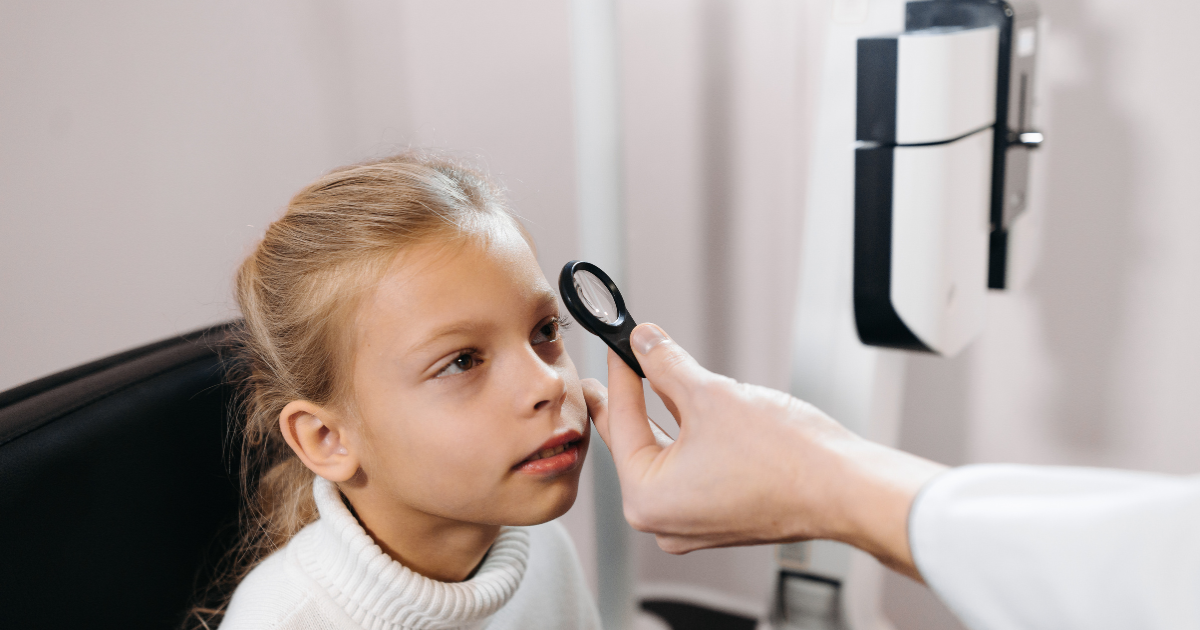
A pediatric examination is adapted to the child’s age, language, confidence, and ability to respond. Young children do not need to know letters or provide detailed verbal answers for an eye doctor to collect useful information.
Testing may use pictures, matching cards, lights, toys, lenses, or objective instruments. The doctor may observe how the child follows a target, whether the eyes align, and how each eye responds when the other is covered.
Dilating drops may be recommended to relax the child’s focusing system and allow a more complete examination of the internal eye. Temporary light sensitivity or blurred near vision can occur afterward. Parents should ask what to expect and whether sunglasses would be helpful.
Bring information about:
- Pregnancy and birth history, including premature birth
- Developmental or medical conditions
- Current medications
- Previous vision screenings
- Family history of childhood eye disorders
- Teacher observations
- Specific symptoms and when they occur
Helping a Nervous Child Feel Prepared
Parents can explain that the eye doctor will ask the child to look at pictures, lights, or objects. Avoid promising that no drops will be used unless the office has confirmed this.
Helpful preparation may include:
- Scheduling when the child is normally rested
- Bringing a familiar comfort item
- Using calm, neutral language about the appointment
- Allowing extra time rather than rushing
- Telling the doctor about sensory or communication needs
If a child cannot complete every test, the visit can still provide valuable observations. The doctor may modify the testing approach or recommend follow-up as the child becomes more comfortable.
Screen Time, Outdoor Time, and Everyday Habits
Digital devices do not explain every childhood vision problem, but extended near work can contribute to tired eyes, dryness, headaches, and temporary focusing discomfort. Encourage regular breaks from screens, homework, and other close activities.
Children should also spend time outdoors, sleep adequately, and use suitable lighting for reading. These habits support comfort but do not replace examinations or prescribed treatment.
Outdoor activities introduce another consideration: eye protection. The National Eye Institute reports that the correct protective sports eyewear can prevent most sports-related eye injuries. Ordinary prescription glasses are not substitutes for sport-specific goggles or face protection.
Choosing Glasses a Child Will Wear
When glasses are prescribed, accurate fit matters. Frames should remain stable without pinching the nose, pressing behind the ears, or sliding during normal movement.
Children should be included in choosing an appropriate frame. A pair they like is more likely to be worn consistently. Parents can ask about durable frame materials, lens impact resistance, scratch-resistant treatments, backup glasses, and adjustment services.
The child should follow the wearing schedule given by the eye doctor. Some prescriptions are intended for full-time use, while others may be recommended for particular activities.
Pediatric Eye Care in Robertsdale
Robertsdale Eye Care provides pediatric examinations for families in Robertsdale, Silverhill, Summerdale, and surrounding Baldwin County communities. The practice is located at 21530 Professional Drive, Suite D, in Robertsdale, Alabama.
Its pediatric evaluations may include visual acuity, eye alignment, depth perception, binocular function, refractive testing, and an assessment of overall eye health. The team uses a calm, child-friendly approach and explains the examination in age-appropriate terms.
Early Information Supports Better Decisions
Pediatric eye care is not only about deciding whether a child needs glasses. It evaluates how vision is developing, whether the eyes are healthy, and how effectively the visual system supports everyday tasks.
Screenings, comprehensive examinations, parent observations, and teacher feedback each contribute different information. When concerns are investigated early, families can make informed decisions about correction, monitoring, treatment, or referral while a child’s visual system is still developing.