Growing Eyes: Children’s Eye Exams in San Juan Capistrano
Children’s eye exams in San Juan Capistrano, CA can evaluate developing visual skills that a brief screening or a child’s ability to read an eye…

Children’s eye exams in San Juan Capistrano, CA can evaluate developing visual skills that a brief screening or a child’s ability to read an eye chart may not fully reveal.
Children rarely describe vision problems the way adults do. A young child may not know that the words on a classroom display should look sharper or that using both eyes together should feel easier. If one eye sees better than the other, the stronger eye may compensate well enough for the difference to remain unnoticed.
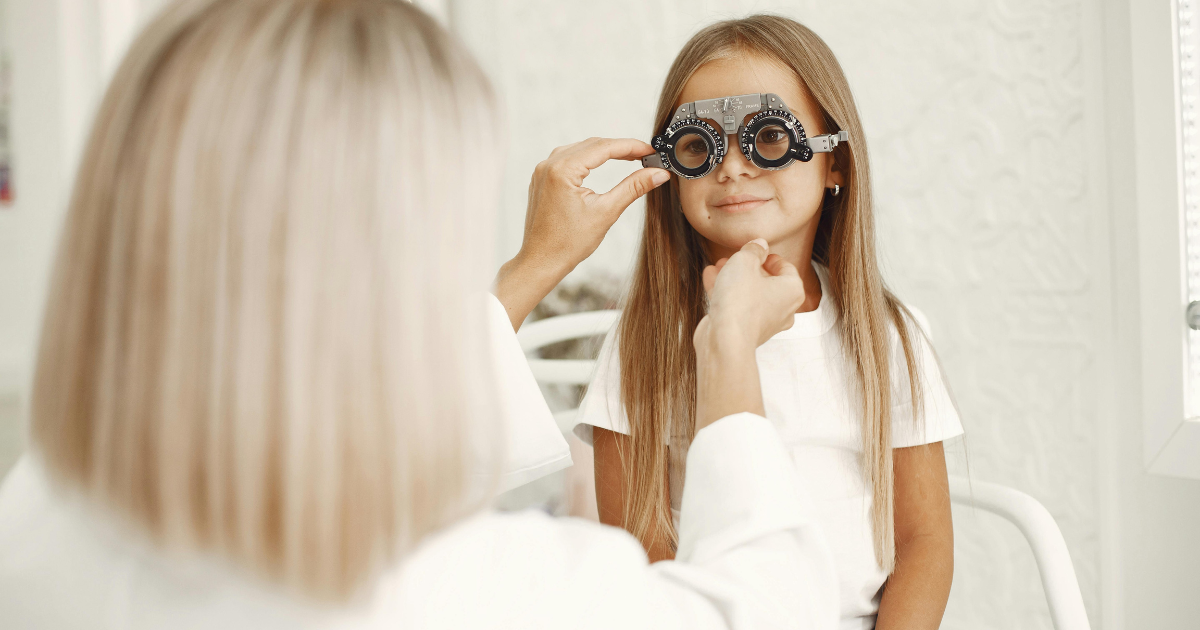
Pediatric eye care is designed around this challenge. Through age-appropriate activities, observation, objective measurements, and clinical testing, an optometrist can examine children who cannot yet read or explain exactly what they see.
A child’s visual system develops rapidly during infancy and early childhood. The eyes must focus clearly, align correctly, move together, and send useful information to the brain. These abilities support tasks ranging from recognizing faces to tracking a moving object and shifting attention between near and distant targets.
Changes can continue throughout the school years. Growth may alter the shape of the eyes, and new visual demands can make previously unnoticed difficulties more apparent.
The Centers for Disease Control and Prevention identifies refractive errors, amblyopia, strabismus, and convergence insufficiency among the vision problems that can affect children. Because symptoms are not always obvious, routine care and appropriate follow-up remain important.
Vision screenings provide an efficient way to identify children who may require additional evaluation. They may be performed at school, during a pediatric visit, or through a community program.
Depending on the child’s age, a screening may involve reading symbols, matching pictures, observing eye alignment, or using an automated instrument. These checks are useful, but they are designed to be brief and limited in scope.
A comprehensive eye examination is performed by an optometrist or ophthalmologist and evaluates vision in greater detail. The American Academy of Pediatrics explains that children who do not pass a screening should receive a full examination from an eye doctor experienced in evaluating children.
Parents should still mention concerns even when a child has passed a previous screening. A screening result represents one point in time and may not evaluate every aspect of visual function.
The exact tests depend on the child’s age, communication ability, symptoms, and health history. Pediatric examinations may evaluate:
Children do not always need to identify letters. Picture charts, matching games, lights, moving targets, and objective instruments can provide useful information without depending on advanced reading skills.
The optometrist may also use dilating drops when appropriate. Dilation relaxes the focusing system and provides a wider view inside the eyes, although the specific testing plan should be determined for each child.
A refractive error occurs when light does not focus correctly on the retina. The National Eye Institute identifies nearsightedness, farsightedness, and astigmatism as common refractive conditions.
Nearsightedness generally makes distant objects appear blurry. A child might see books clearly but struggle with classroom displays or distant signs. Farsightedness can make close work more demanding, although children sometimes compensate by using their focusing ability. Astigmatism may blur or distort vision across multiple distances.
Possible behaviors include:
These behaviors can have several explanations and do not confirm a refractive error. They are observations worth sharing with the eye doctor.
Clear vision in each eye is only part of the picture. The eyes must also point toward the same target and coordinate their movements. When alignment differs, the brain may receive images that are difficult to combine.
Strabismus is an eye-alignment condition in which one or both eyes may turn inward, outward, upward, or downward. The turning may be constant or intermittent. Some cases are easy to notice, while others are subtle.
A child may tilt the head, close one eye, or avoid certain visual tasks. However, the absence of these behaviors does not guarantee that alignment and eye teaming are functioning normally.
Amblyopia, commonly called lazy eye, occurs when vision does not develop normally in one eye or, less commonly, both eyes. It may be associated with unequal refractive errors, strabismus, or another condition that interferes with clear visual input.
The American Association for Pediatric Ophthalmology and Strabismus explains that the brain may increasingly rely on the stronger eye, allowing the weaker eye’s vision to remain underdeveloped.
A child with amblyopia can appear to function normally because the stronger eye supports everyday activities. Testing each eye separately is therefore important. Treatment depends on the cause and may include glasses, patching, medication, or referral for specialized care.
Recommendations differ according to age, risk factors, symptoms, and previous findings. Vision should be monitored during routine pediatric care, with comprehensive evaluation when a screening identifies a concern or when parents notice unusual visual behavior.
The U.S. Preventive Services Task Force recommends vision screening at least once between ages three and five to detect amblyopia or its risk factors.
The American Association for Pediatric Ophthalmology and Strabismus also publishes age-based guidance covering examination and referral criteria from infancy through childhood.
Children with glasses, contact lenses, progressive myopia, previous eye findings, certain medical conditions, or a family history of childhood eye disease may need more frequent care. The child’s optometrist can recommend an individualized schedule.
Myopia, or nearsightedness, often begins during childhood and may progress as the eyes grow. Updating glasses can restore clear distance vision, but some children may also be candidates for strategies intended to slow progression.
Management options require individualized discussion. They may include specialized contact lenses, orthokeratology, certain spectacle-lens designs, or prescribed low-dose atropine. Each approach has different benefits, limitations, risks, and monitoring requirements.
The American Association for Pediatric Ophthalmology and Strabismus provides an overview of strategies used for increasing childhood myopia. The National Eye Institute continues to support research comparing emerging methods.
Parents should not select a myopia-control treatment based only on advertising or another child’s experience. A professional evaluation is needed to determine whether treatment is appropriate and how progress should be monitored.
An examination captures how a child performs during one appointment. Parents and teachers observe the child across many different tasks and environments, so their descriptions can provide valuable context.
Information worth sharing includes:
These signs do not establish that a vision condition is responsible. Reading and learning difficulties can have many causes. Eye care can determine whether uncorrected vision or visual function may be contributing.
A simple, positive explanation can make the examination feel less intimidating. Parents can describe the visit as a series of games involving pictures, lights, and looking activities. Avoid suggesting that the child must pass or provide perfect answers.
Bring:
Scheduling the appointment when the child is normally rested can also help. Young children may need pauses or different testing methods, and cooperation can vary from one visit to another.
What a Spectacle Optometry provides pediatric eye care for infants, children, and teenagers in San Juan Capistrano. The practice incorporates age-appropriate techniques and technology to evaluate children’s vision while creating a positive examination experience.
If an examination identifies a concern, Dr. Michelle Ahumada may discuss options such as eyeglasses, contact lenses, vision therapy, myopia management, or referral for additional care. Recommendations depend on the individual findings rather than a standard plan for every child.
The office is located at 27221 Ortega Highway, Unit F, in San Juan Capistrano.
Pediatric eye care should not depend on a child recognizing and reporting blur. Children may adapt to vision differences, rely on a stronger eye, or lack the words needed to describe what they experience.
Screenings help identify many children who need further evaluation, while comprehensive examinations provide a closer assessment of visual clarity, focusing, alignment, eye teaming, and ocular health.
Parents can support the process by observing visual behavior, following up after an unsuccessful screening, and sharing accurate medical and family history. When age-appropriate testing is combined with these real-world observations, families receive a clearer picture of how a child’s vision is developing and whether additional care may be beneficial.